Felipe E. Jose was Grandma Pam’s dad. He was a teacher, journalist, playwright, car salesman, optometrist, labor leader, Freemason, politician, nation-builder, civil servant, and businessman. He spoke at least five languages. He was on the Baguio City Council. He helped write the 1935 Philippine Constitution, which created the transitional Commonwealth of the Philippines and laid the foundation for independence from the US Empire in 1946. At perhaps the height of his career, he was the Director of Labor under President Quirino, but then he was removed from office for corruption. And then a year later, they changed that removal to a “resignation.” After that, I think he joined the Escolta Walking Corporation? This guy did a lot of stuff!
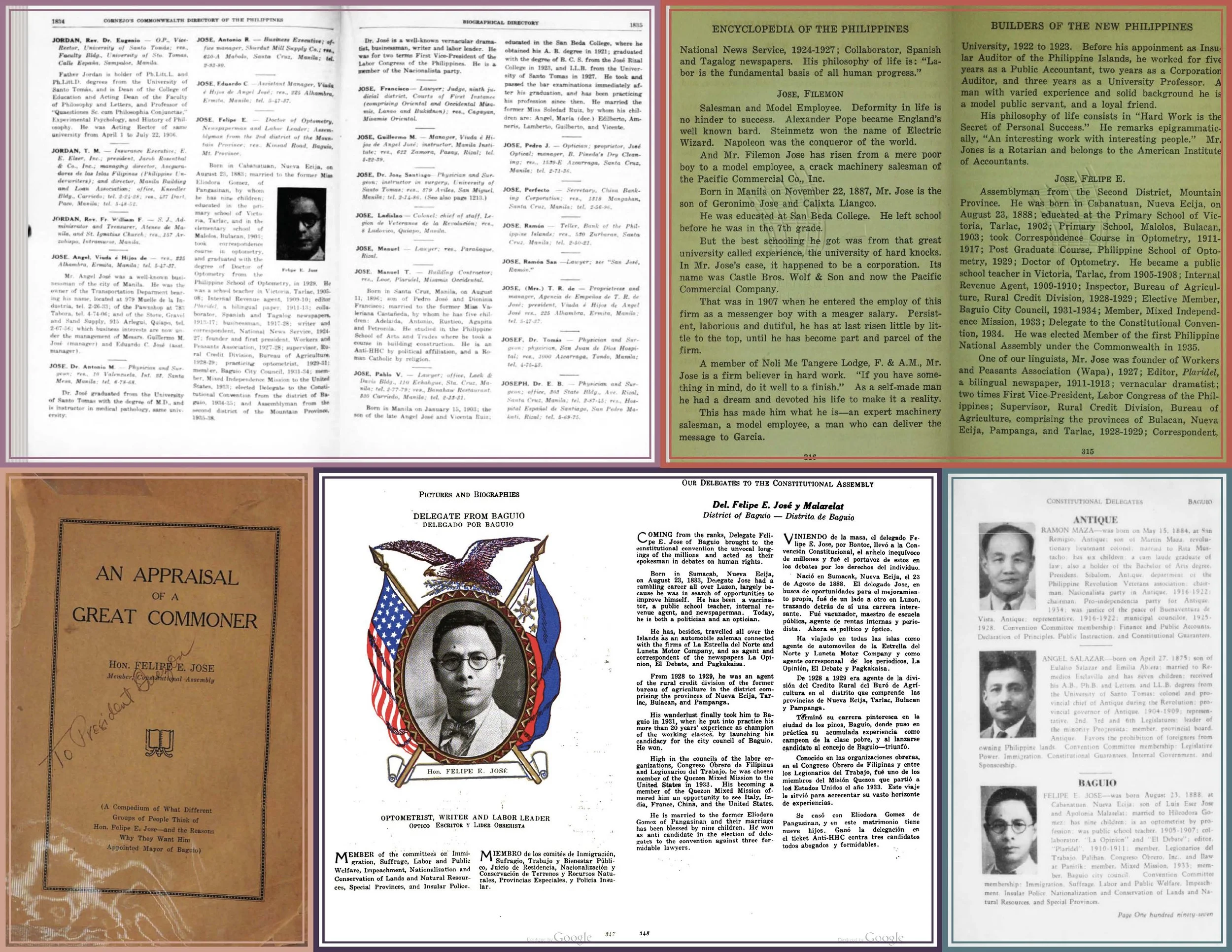
A collage of accounts of Felipe E. Jose and his life up until the mid 1930s.
Alright, here’s what we can gather about Felipe’s timeline.
He was born on August 23, 1883, in Sumacab, Cabanatuan, Nueva Ecija, to Luis Eser Jose and Apolonia Malarulat.
He went to primary school in Victoria, Tarlac (1902), and then elementary school in Malolos, Bulacan (1903).*
School teacher in Victoria, Tarlac from 1905-1908.
On September 21, 1908, at the age of 25, he married Heliodora Gomez (age 20) in Bautista, Pangasinan.
Internal Revenue agent from 1909-1910.
Editor for Plaridel, a Tagalog-Spanish bilingual newspaper from 1911-1913.
Collaborator for Tagalog and Spanish newspapers (La Opinion, El Debate, and Pagkakaisa) from 1913-1917.
“A businessman” from 1917-1928. I believe this is referring to his time as an automobile salesman for La Estrella Del Norte and Luneta Motor Company.
Writer and correspondent for the National News Service from 1924-1927.
Founder and first president of the Workers and Peasants Association from 1927-1928.
Supervisor for the Rural Credit Division of the Bureau of Agriculture from 1928-1929.
Became a Doctor of Optometry from the Philippine School of Optometry in 1929, and practiced from 1929-1931.
Member of Baguio City Council from 1931-1934.
Mixed Independence Mission to the United States in 1933.
Elected Delegate to the Constitutional Convention from the District of Baguio in 1934-1935.
Assemblyman from the second district of the Mountain Province, 1935-1938.
1935-1941 played golf with Quezon and MacArthur (the family was next door neighbors to the Quezons and the kids grew up together)
In 1936, it was said “His philosophy of life is: ‘Labor is the fundamental basis of all human progress.’”¹
In 1939, he was described as “a well-known vernacular dramatist, businessman, writer, and labor leader. He was for two terms the first Vice-President of the Labor Congress of the Philippines. He is a member of the Nacionalista party.”²
In 1941, Heliodora died of high blood pressure, and, Grandma Pam speculates, the stress of finding out Felipe was having an affair with his secretary, Rufina, whom he shortly married while Grandma Pam was still in high school.
Felipe and Rufina S. Caparas were married in Manila in May 24, 1942 (he was 53, she was 24…)
During the war, from 1941-1945, the family was running from town to town, being hidden by the people, to avoid being held hostage by the Japanese. Felipe and Rufina and Grandma Pam were together, at one point living in chicken coops in Bulacan, or hiding in dugouts as the Japanese walked past searching the family hiding them’s house. Felipe dressed Grandma Pam and other sisters up as small boys. They were the first people the Americans saw when they landed in Lingayan. Peets and Toots were together in the house the family had in Manila.
*I don’t understand these dates because he would have been 19-20 at this time.
I’ve been able to find this information about Felipe from encyclopedias, write-ups of congressional delegates, and history books. Perhaps one of the most interesting of the primary sources I’ve seen is a booklet called “An Appraisal of a Great Commoner: Hon. Felipe E. Jose,” which is “A Compendium of What Different People Think of Hon. Felipe E. Jose–and the Reasons Why They Want Him Appointed Mayor of Baguio.” It’s essentially a collection of testimonies addressed to the Governor-General of the Philippines and President of the Senate, advocating for Felipe to be appointed mayor of Baguio in the wake of the city’s last American mayor, E. J. Halsema, tendering his resignation. He never became mayor (Quezon appointed Sergio Bayan in 1937), but the document is chock-full of interesting (if, again, sometimes contradictory) bits and bobs.
This book is filled with glowing praise about his integrity, work ethic, leadership, and love of country and the everyman, from civil servants and citizens and governmental bodies from all over Luzon. People speak of his “ambition to serve the working class” and how he “has shown unselfish interest in the welfare of the laboring class, especially of the mine-workers, chauffeurs, and street-cleaners of the City of Baguio.”
“He may be outspoken sometimes, but his assertiveness is always tempered with a readiness to respect others’ views and rights.” –Resident Commissioner Francisco A. Delgado
Of interest to maybe just me, the Governor of Ilocos Norte and others submitted a petition stating Felipe spoke “English, Spanish, Tagalog, Pampango, Igarot, and Ilocano,” while another letter says he “speaks and writes English, Spanish, Tagalog, Ilocano, and Pangasinan.” For context: Igorot is a collective term for around ten Indigenous ethnolinguistic communities in the Cordilleras (it’s not one language), Pampango is another word for Kapampangan, and I just think it’s just cool that he might have spoken Pangasinan.
This document is also filled with so many little clues to a historical political landscape that I have so many questions about. Emerging for me are:
Tensions between the working class and capitalists/”business leaders” (“We believe and hold that the circumstance of Mr. Jose's being a labor leader cannot be a drawback to a program of efficient and honest administration of Baguio in the event he is appointed.”)(“Baguio wants a New Deal. Its people need it. And thanks to the inborn love of liberty and justice of the American people, that New Deal so long delayed and so long hoped for will soon become a reality.”)
A need to declare love for and loyalty to the United States while simultaneously desiring a transition to Filipino leadership (“We have known Mr. Felipe E. Jose to be a man of integrity, loyal to the sovereign government of the United States and one who loves his country very dearly.”) (“Permit us to state that we have no complaint whatsoever against the present administration of Baguio, much less against Mayor Halsema personally.”)(“WHEREAS, with the recent resignation from office of the Honorable E. J. Halsema as City Mayor of Baguio, the appointment of a Filipino to the mayoralty of Baguio comes as a logical step in view of assumption of the rights and responsibilities of self-government by the Filipino people under the forthcoming Commonwealth Government.”)
Allusions to expected tensions between the ethnolinguistic communities of Luzon (“It might interest you to know that the spirit of sectionalism or racial feeling has not been allowed to rear its head in the present move. Among the signers of this letter and that addressed to the Governor-General are Tagalogs, Ilocanos, Pampangos, Pangasinan, Chinese, Japanese, etc.”).
Another tension I often think about when it comes to Felipe is the designation of “Filipino” (Tagalog) as the national language, transitioning from the official languages Spanish and English. During the drafting of the 1935 Philippine constitution, Felipe argued:
“Bilang na ang mga araw ng pagka-alipin at pagiging palaasa at darating na ang araw ng kalayaan. Ang Espanya at pagkatapos, ang Amerika, ang mga makapangyarihan na ang kultura ay ipinilit sa atin, ay paalis na bilang mga kongkistador ng nakaraang panahon. At ang natitira ay ang ating panahon — ang panahon ng mga Pilipino kung kailan dapat nating itayo ang isang bagong bansa na may sariling kultura, sibilisasyon, kayamanan, karangalan, kapangyarihan, at wikang pambansa.”
(The days of enslavement and dependency are numbered and the day of freedom is coming. Spain and America, colonial powers that imposed their culture on us, are leaving. And what remains is our time — the time when we Filipinos can build a new nation with its own culture, civilization, wealth, honor, power, and a national language.)
The first National Assembly of the Philippine Commonwealth (of which Felipe was a member) was charged with taking “steps toward the development and adoption of a common national language based on one of the existing languages.” Six major regional languages got representatives to lead the newly created Institute of National Language, even though there are around 175 different ethnolinguistic groups in the archipelago designated “The Philippines” by the Spanish colonizers to honor this inbred, incestuous idiot:

Yuck.
Okay sorry anyway so Felipe advocated for Tagalog to be the national language of the Philippines but that’s really fraught because it’s a very Manila-centric choice (Manila being a repeated site of colonial power). Also, Tagalogs weren’t even as populous as Visayans. AND, obviously, having any nation-state impose one single language onto a highly ethnolinguistically diverse territory that was arbitrarily lumped together by a colonizer, instead of honoring and protecting the rich linguistic diversity of the archipelago, is going to result in the same erasure that colonialism perpetuated. More to be said about “Imperial Manila” in a later post, but suffice it to say Felipe was working directly within the tensions of nation-building that both sought to be free from and also reproduced colonial paradigms.
From 1935-1938 (the first National Assembly years), Felipe and our family may have been between Manila and Baguio?
1941-1945 were the WWII Japanese occupation years – does anyone know where the family was during this time?
He was appointed Director of Labor under President Quirino on February 15, 1949.
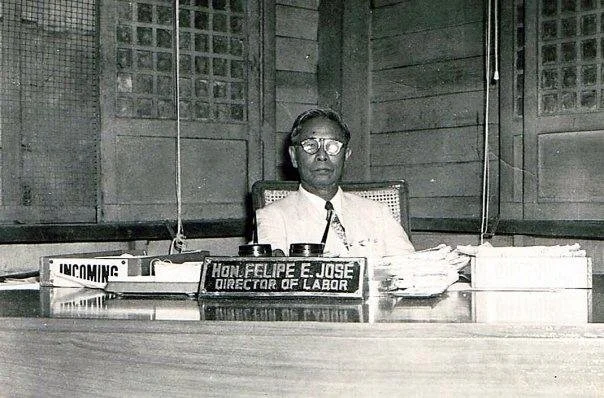
Director of Labor Felipe E. Jose at his desk. He always looks so severe to me in the pictures I’ve seen.
On July 7, 1951, Felipe was removed from office for “abuse of authority, bribery and corruption.” According to Administrative Order No. 161, there were four evidenced charges:
He widely recommended one detective agency at the expense of another, the stability of which he lied about.
He overused government cars past the travel expense fund limits, and compelled the account officer, who repeatedly warned him to lie about the fund availability, and also to lie that Felipe was using the cars to inspect Chinese businesses when his second wife was campaigning for “Mrs. Philippines of 1949.” (I think this would have been Rufina, Grandma Pam’s stepmother, whom the kids didn’t like very much.)
He got problematically informal about hearing labor violation complaints without the professional formality or accountability of witnesses or records, and would sometimes change his mind about a decision and significantly reduce fines after respondents visited him.
The deposits to his children’s bank accounts were (if I’m interpreting this language correctly), the same as the disparity of the “reduced” fine amount.
A year late, Administrative Order No. 185 basically stated that because he’d “been sufficiently punished and that the public interest has already been served,” and he’d “rendered long and satisfactory service to the Government, and to deprive him of whatever benefit might have accrued to him for such public service would be unduly harsh and oppressive,” the original administrative order would be modified to consider Felipe as having voluntarily resigned.
I feel so disappointed that my great grandfather seemed to start his career as such a champion of the working class with so many people attesting to his integrity, only to become corrupt.
There are also so many declassified documents from this time period around US counter-intelligence, combating the communist party of the Philippines, and monitoring Filipino labor organizations. It makes me think of the success of post-colonial Asian economies, which had successful peasant revolutions and redistribution of land after colonialism, as opposed to economies like the Philippines, which were successfully parasitized by US politico-corporate interests, and which are now characterized by dynastic political families and corruption. [There is a book about this somewhere in my library; I will find and cite it.]
I think wealth inherently corrupts, I think power inherently corrupts, and I think having to work within the forces and systems of colonialism and capitalism and Western imperialism probably inherently corrupts too.
ANYWAY. After his directorship ended, it’s hard to find what happened to Felipe. There were some sources online a few years ago that led me to believe he joined the Escolta Walking Corporation, a sort of social-political-business club, but I can’t find them anymore. I’ll try to keep looking.
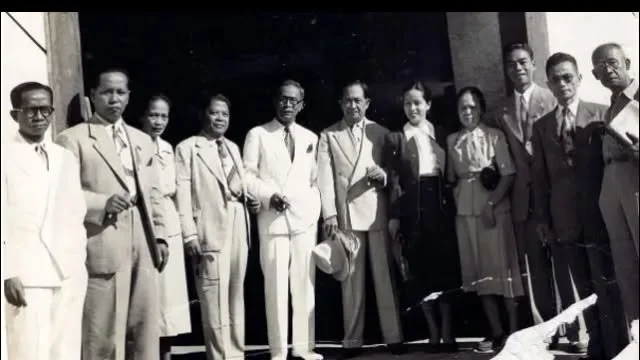
When is this? Who are these people?
I also haven’t been able to find when or where he died, but I’ll keep looking for those records too.
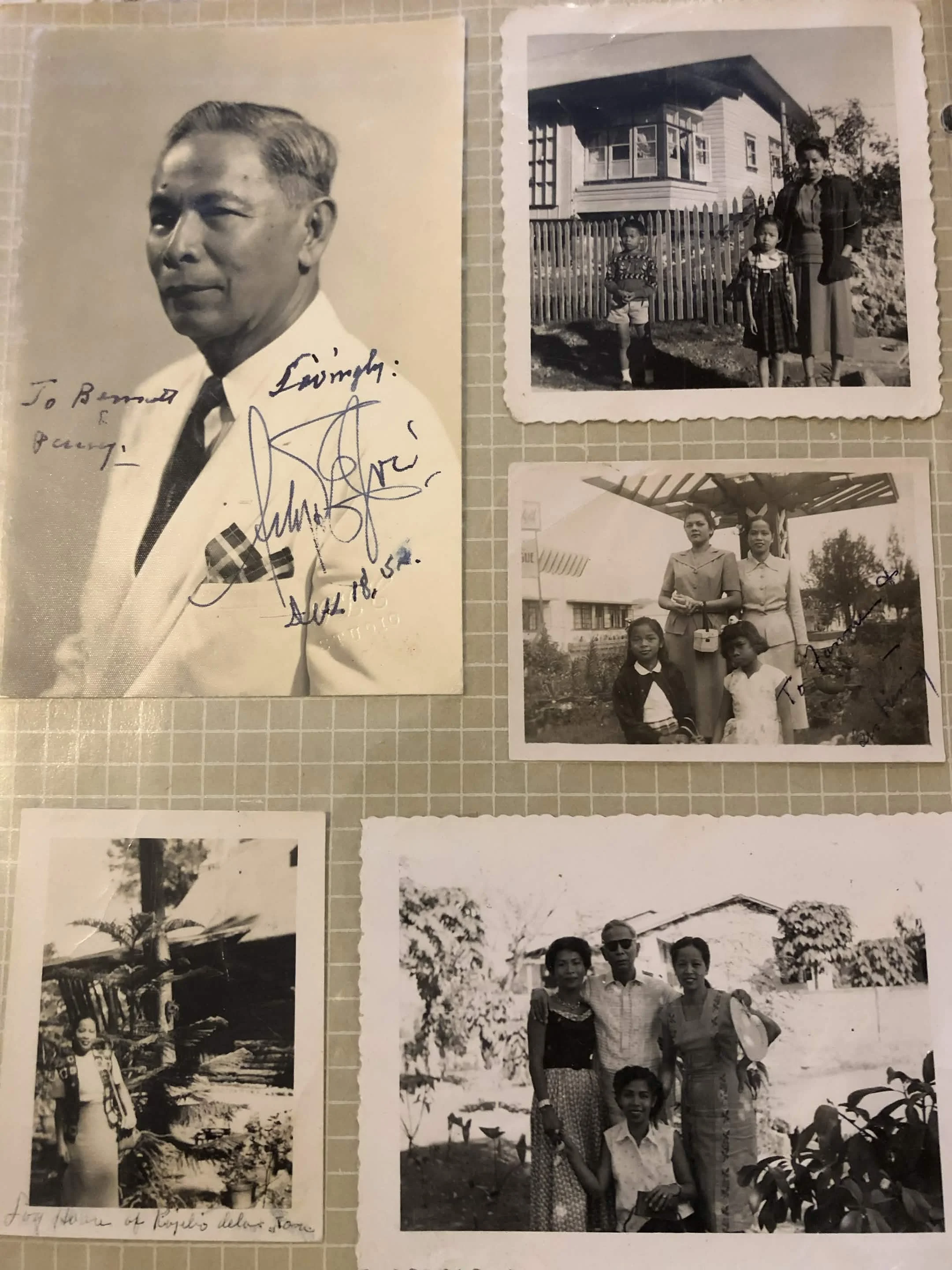
I think the top left is from December 18, 1957? Bottom right is Grandma Pam, GG Felipe E. Jose, Grandauntie Luninging, and Grandauntie Lil.
He died in 1967 of throat or lung cancer (he was a big cigar smoker).
¹ Cornejo, Miguel. Cornejo’s Commonwealth Directory of the Philippines. 1939.
² Encyclopedia of the Philippines: The Library of Philippine Literature, Art and Science, Volume 9: Builders of the New Philippines. 1936.